









Introduction
Our association with sound has been passive over the last 100 years. We are victims of what we listen to in life. We are exposed to the shocking alarm clock, the constant traffic noise, the cacophonic noise of open offices, and the bass-thumping of the next-door room. It has taught us that noise is the cost of entry to the contemporary life and silence is the luxury of some distant retreats or the dead of night.
Yet there is an acoustic revolution coming in the technology of consumption. It is one of these changes that causes us to stop being blocked by sound and instead begin to sculpt sound. The movement is already characterized by one, sounding term: miuzo.
It might sound like an idea of a speculative fiction novel, but miuzo is the future of soundscape architecture of adaptation. It is the science and art of the design of individualized, dynamic auditory landscapes that react on-running to our biometric information, our actions and our emotional moods. It is the process of listening to music and becoming a part of it.
As a deep-dive, we are going to discuss the origin of the miuzo philosophy, the neuroscience underlying its effectiveness, and how this new technology is going to change the ways we are productive, feel psychologically, and how we perceive the world itself.
The Issue of Noise Cancelling.
We need to know the need of miuzo first by examining the inability of the contemporary audio technology. Active Noise Cancellation (ANC) has been the gold standard behind focus and peace in the past ten years. ANC is an unsophisticated tool, as it is effective. It creates a vacuum. It silences the hectic and noisy world.
Nevertheless, neuroscientists have found out that complete silence does not necessarily have to be the aim. Human brain adapted to scan the silence, as in the nature, a complete silence usually indicates peril. Even a fully silent audio space is as distracting as a noisy one, which results in a condition called sensory deprivation anxiety.
Moreover, ANC does not discuss the quality of the sound that is left. It do not assist in you being focused, it only eliminates the distraction. Miuzo, on the contrary, is additive but not subtractive.
Muzo is based on the principle of sound as a utility. Like with light in a room that we can always manage to fit the room to a specific mood with dim lighting during a romantic dinner and bright lighting during surgery, we must be able to change the sonic texture of our building. The delivery system of this utility is Miuzo. It entails algorithms to create so-called sound masks, complex layers of natural environment, optimized white noise, harmonic frequencies, but not to cover the world, but to blend with it.
Soundscape and the Neuroscience of Soundscape.
Why is it that we feel like falling asleep when it rains upon a tin roof? Why is it that coffee shop hum is so creative? The solution is in our evolutionary biology.
The sense that even when we sleep, is not in slumber and is fully awake is our auditory system. It acts as a sentinel. The amygdala (the brain center of fear) is triggered through sudden and sharp sounds, and the body is ready to fight or run. This occurs unconsciously. Although you may not recognize it, your body is noting the stress even though you are not conscious of being aggravated when you are making your watch tick or the highway humming in the background.
The miuzo method goes back to the study of the perception of sound, which is psychoacoustics. Miuzo systems operate on bio-feedback loop whereby your body is undergoing a stressed state. Or you may even have a slowing of the heart rate variability (HRV) or an increase in the skin conductance. The miuzo algorithm automatically alters the aural space.
As an example, consider a situation where one is working in a high-stress environment. It is possible that a conventional playlist will be playing a fast-paced music, further contributing to the overload of senses. A miuzo based device would sense your body in a state of physiological stress and automatically adjust the audio output. It may slow down the speed, add some pink noise (deeper and more gentle than white noise) and add some biophilic elements such as rustling leaves or running water. The sound activates the parasympathetic nervous system which tells your primal brain that you are not in danger and as a result, you trigger reduced levels of cortisol and your prefrontal cortex is free to process well without interference.
Miuzo Practically: Architecture of Focus.
The first area where miuzo technology can be applied is in the productivity area. In a time when our attention is our most precious asset, anything that takes it away is the enemy. Distraction is not only a matter of will power but it is a matter of acoustic interference.
The contemporary open-plan office is an audio nightmare. It is soup of half-heard chatting, ringing telephones, clattering keyboards. This places a sort of mental burden on us that drains us out by mid-afternoon.
Enter the Miuzo Workspace.
At miuzo-powered workspace, workers do not simply put on headphones; they go into a sonic zone. Through spatial audio technology, the miuzo software establishes a sound bubble of the user. However, rather than simply cancelling noise, it translates noise. The stinging tones of a keyboard could be mellowed into non-mechanical rhythmic beats. The voices could be changed into a low soothing chord.
This is referred to as Stochastic Resonance. The miuzo engine provides a pleasant enough background noise to blend in noises of the environmental noise making the jarring peaks of noise a lot less noticeable, essentially raising your brain a threshold of the noise that qualifies as a distraction. The outcome is a state of entranced concentration that may last hours without the mindfulness exhaustion that comes with the concentration used traditionally.
The Emotional Implications: Soundtrack to the Soul.
In addition to productivity, miuzo addresses the depth of the feeling of sound and emotion. We have all gone through the catharsis of listening to an emotional song when we are heartbroken, or the pump-up songs before a physical exercise. Miuzo does it one step further: it makes the emotional supporting active as opposed to passive.
Suppose there is a wearable, a miuzo, a small earbud or even a bone-conduction device that merges with your calendar and even your biometrics.
The Morning Commute: You are worn out and you hate the day. Miuzo will sense your lack of energy and will run a calming and slowly building soundscape that resembles the speed of a morning sunrise, slowly putting you back to sleep without the shock of an alarm.
The Afternoon Slump: You lose concentration. Miuzo adds high-focus beta-wave frequencies which it might hide as either the noise of the library around you, or some noisy walk in the woods, to poke your brain into paying attention again.
Social Anxiety: You have just gotten to a party with a lot of people. Your heart rate spikes. As soon as you hear Miuzo, he creates you a shield of familiar and relaxing sound to keep you on the ground and reduce the level of anxiety in order to be able to socialize.
This is where the miuzo idea is made a way of life. It is the notion that we are able to cultivate our inner emotional environment by controlling the outer sound environment. It is a kind of audio- Therapy that is always playing in our lives as the background music.
The Design Aesthetic: The Miuzo World of Living.
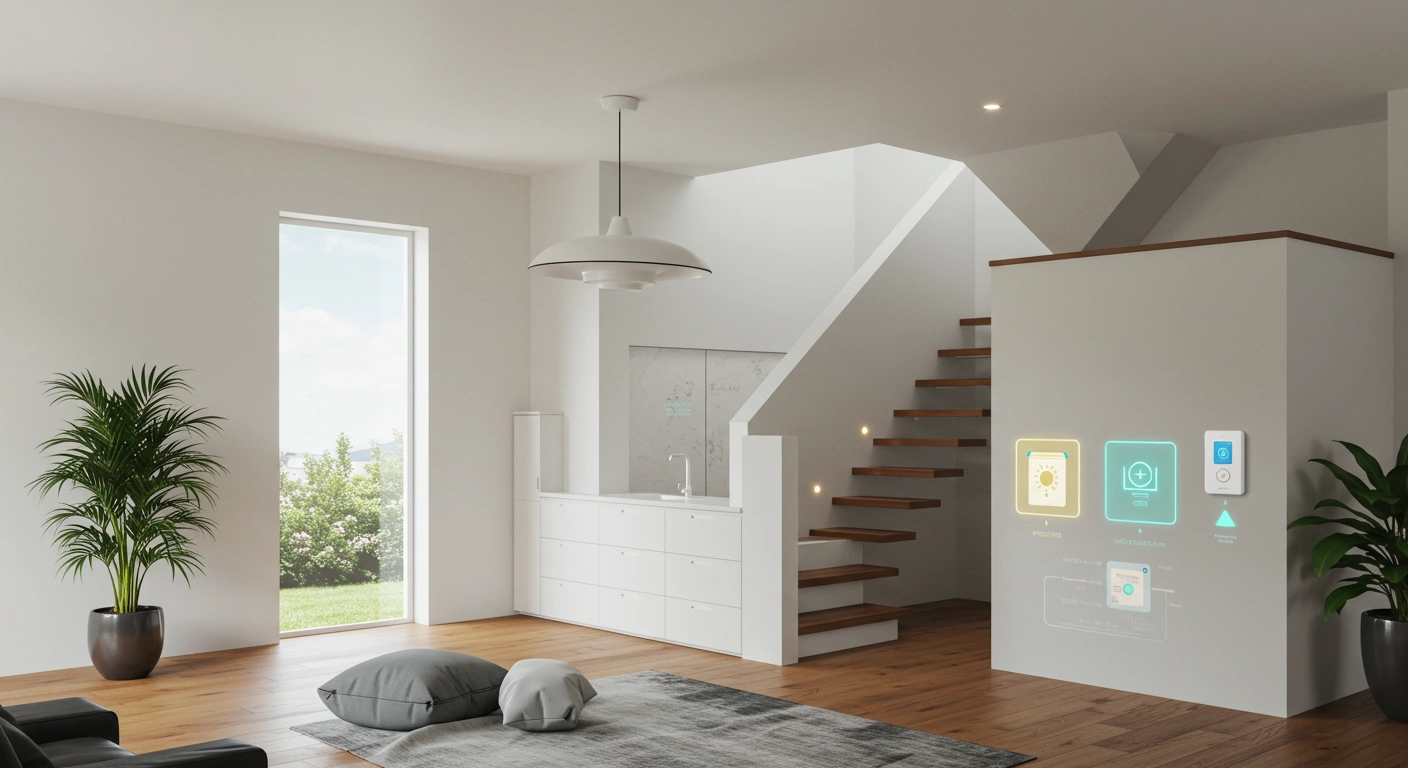
Muzo is presently restricted to a significant degree to headphones and other personal devices. Nevertheless, miuzo has a future in architecture. The trend with Smart homes is now to be obsessed with visual intelligence, such as smart lights that change color, smart blinds that adapt to the sun. The second wave is intelligent acoustics.
Suppose that there is a home fitted with miuzo sensors. When a storm comes the house not only keeps the thunder out it may enhance the sound of the rain on the roof in a harmonizing manner making the storm look like a movie. When an obnoxious truck is passing by outside the windows might also release an anti frequency to cancel out the sound wave before it even reaches your ear and instead of hearing the sound of wind chimes you heard the sound of wind chimes.
This brings about the idea of Sonic Interior Design. As we select the paint color and furniture texture, we will start selecting the sound signature of our rooms. A living room may play a sound profile called Warm Social, which is a sound profile that suppresses the high frequencies and promotes quieter and intimate conversation. One of the bathrooms could be programmed to become a “Spa” and use water sounds and reverb to experience the feeling of endless calmness.
The Ethics of Artificial Peace.
Like in any technology, which changes our vision of reality, the emergence of miuzo raises ethical questions. And in case we are able to design our soundscapes to perfection, will we lose sight of what the world is like?
And in case a city is upset and hectic, maybe we are supposed to hear it. It could encourage us to improve the city world, to insist on better acoustic and noise protection, quieter vehicles and more vegetation. When we recede into our miuzo bubbles, which are perfectly isolated and sonically gratified, are we now insensitive to noise pollution which afflicts us who cannot afford that technology?
We stand the risk also of letting the Filter Bubble creep over to the sense. We are already filtering our news feeds and our social lives. By beginning to filter our senses, we will be putting ourselves in danger of having an inoculated life where we never feel uncomfortable, never get surprised, never really in the physical world.
The only way to be resilient is to live in the unclean and unsanctified world. A society that has become dependent on miuzo may also have a reduced stress threshold, which may not be able to operate in case the battery runs out.
As such, miuzo philosophy has to be a philosophy of balance. It must be a means of healing, rather than an armour-plate. It must be recharged so that we may be able to interact with the world, and not to withdraw.
The Future Horizon
Nevertheless, after these warnings, the trend is evident. Audio business is shifting towards software (better listening experiences) and not hardware (better speakers).
The first signs are already being observed on apps such as Calm and Endel that create a customized soundscape that can be used to sleep or concentrate. Nevertheless, it will take the merger of AI, biometric sensors, and spatial audio to implement miuzo fully.
Muzo can be expected to be integrated into in the next few years:
VR and the Metaverse: As the virtual worlds get more interactive, miuzo will be the driver that will make them feel real and create dynamic soundtrack that responds to both movement and interaction by users, instead of repeating soundtrack in the background.
Automotive Industry: automobiles that can modify the engine sound and the in-car atmosphere according to the stress levels of the driver, making the ride to work safer and more comfortable.
Healthcare: Hospitals employ miuzo technology to shorten recovery durations of patients through decreasing the so-called alarm fatigue and establishing healing aural atmospheres in ICU areas.
Conclusion
Sound is something that we cannot see, but sound constructs our reality in ways that are far reaching. It controls our mood, capacity to think and quality of sleep. We have too long been ride in the sound carriage, and at the mercies of our surroundings.
We are handed over to the age of miuzo hands. It is a radical change of the way we relate to the world not by shutting out but by listening purposefully. It brings the promise of a world in which the clatter of modernity does not weigh on us, but is a brute material with which we can work to make an object beautiful and productive, and curative.
It will no longer be a question of what you are listening to. but instead of it being What world are you creating? The question with miuzo is completely a matter of choice.