




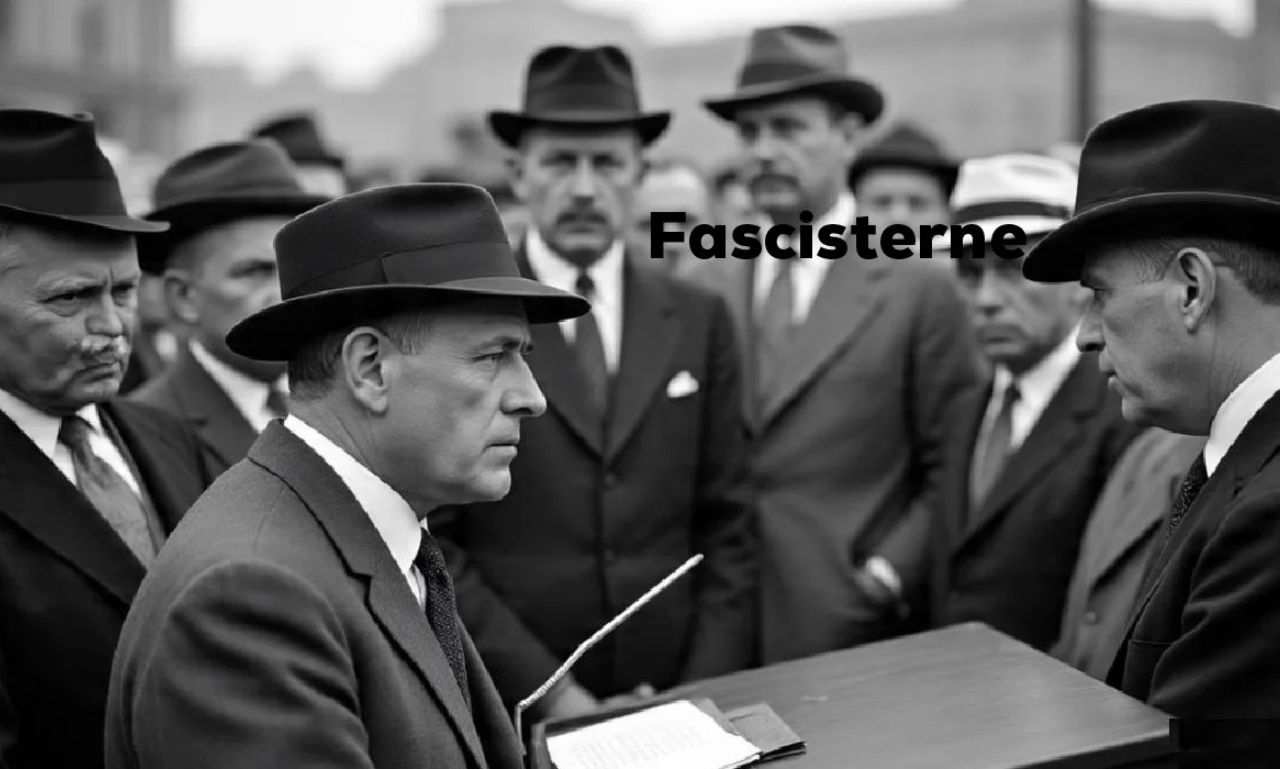
History is a very easy subject to study because it is a matter of recognizing patterns. It is through the analysis of the emergence and demise of political ideologies that we prepare ourselves with the facts on how to cope in the present. Few topics attract as much corporeal response, historical substance and pressing present day impetus as the analysis of fascisterne. Although the name is etymologically based on the Danish language, which means the fascists, its meaning is universal, as it crosses the boundaries to reach the general human experience of authoritarianism and freedom.
The fascist will be a perverse reflection of the most perverse mirror of mankind. It is a reflection of how fear can override the intellect, how the reason to have order can destroy the need of freedom and how the other is demonized to unite power. In this article, the authors attempt to un-peel the phenomenon of fascisterne, its historical context, and its psychological roots, and discuss its disturbing continuation into the contemporary geopolitical scene.
THE Etymology of Fear: Defining Fascisterne.
In order to wrestle around the idea we need to define it. Fascism is a term that is named after the Italian word fascio meaning bundle of rods, frequently tied about an axe. This fasces was a symbol of power of the magistrate and the strength of unity, one rod can be bent, but not a bunch, in ancient Rome. It was a representation of one united power and authority.
Nevertheless, at the beginning of the 20 th century, Benito Mussolini National Fascist Party co-opted this symbol. When we say fascisterne we are citing the members of this particular ideology and its further mutations. However, it is more complicated to define fascist with references to a dictionary. Theorists of history and political science such as Umberto Eco and Roger Griffin have spent decades arguing about the nature of the ur-fascism or the fascist minimum, the defining characteristics of the movement.
Fascist are not just dictators, they are retrogressives. They are not merely interested in taking over the state; they are eager to take over the spirit of the nation. Their ideology is defined by cult of tradition, anti-modernism, fear of others and anxiety to appeal to stifled middle classes. These traits help us know that fascitterne is not only there in the grainy black-and-white images in the 1930s, but also in the movements that agitate along the fringes of our own societies.
The Historical Crucible: Europe in Interwar Years.
Fascist came into existence as a significant political party which was brought about by the anarchy that followed the World War I. Europe was torn apart. The ancient empires were ruined, the economies were destroyed and the looming threat of communism was looming over the status quo. People in this vacuum needed something to hold on to.
Fascistre was a promise of an attractive promise in Italy, in Germany and in some parts of Europe, a rebirth of greatness. They would clear the corruption of the liberal democracy, which according to them, had caused the humiliation of the country. They presented a middle ground between apparent anarchy of capitalism and apparent despotism of socialism.
This is because failure of traditional institutions made the emergence of fascisterne possible. The strongman leader came in as a substitute to parliaments which were stalemating and politicians who appeared self-serving. The principle of leadership the category that a single person represents the will of the people turned out to be the main one of fascisterne. This is a crucial historical background. It is a reminder that these movements do not grow out of nothingness, but they flourish on the failures of the status quo.
The Psychology of the Movement: The Reason They Joined.
Why is one of the most sinister questions in the history that historians ask. What made millions of ordinary people identify themselves with fascisterne? One is tempted to rate them all as monsters but the act of dismissing them this way is a perilous oversimplification and it overlooks the psychological manipulation that had happened.
This is what fascisterne is tempting with the promise of belonging. The movement is a homeland to the alienated person who is drifting in a contemporary world where community ties are disintegrating. It provides a uniform, a flag, a salute and a brotherhood. It transfers the insignificance of the individual and gives it the importance of the State.
In addition, fascisterne cleverly use the fear of the Other. The fascist must have an enemy whether it was the Jewish people in Nazi Germany, political dissidents in Italy of Mussolini or minorities in other countries. The fascist leaders derived the population anger by pointing at a scapegoat instead of the structural economic issues. This makes a horrifying unity–a unity that has no foundation on hope, but one on hatred.
The notion of national rebirth or palingenesis is also the focal point. Fascist offers a fiction that the nation is once great, degenerated and needs to be born again through struggle. This story is intoxicating to the historians who have been left behind by history.
Danish Context: A Struggle of a Nation.
A special resonance is found in Denmark by the keyword fascisterne. As most European countries, the dark wave of fascism affected Denmark in the Second World War. The period between 1940 and 1945 was a time of national trauma.
Although Denmark had the intention of safeguarding the Jews in the country, the existence of Danish collaborators, (Danish fascisterne), is still a blemish in the history books. Danish National Socialist Party (DNSAP) and the Frikorps Danmark, volunteers who served in the Eastern Front of the Wermacht, are the local specimen of the worldwide scourge.
In exploring fascisterne in the Danish scenario, betrayal in the ideology is brought out. These were the citizens which became opposite to the democratic principles of their own society and embraced a foreign ideology of conquest. It is an effective reminder that fascism is not only a danger to the outside world, but also to the inside of the body.
The Architecture of Propaganda.
Fascisterne was well ahead of contemporary marketing companies on the value of aesthetics. The Third Reich architecture was designed to overwhelm the individual, the choreography of the Nuremberg rallies, and even the uniform design were all calculated to overwhelm the individual.
The fascist lingo is different. It tends to be ambiguous and based on soil, blood and honor. It eliminates critical thinking to appeal to emotions. The propaganda used by fascists, as George Orwell oftentimes put it, is usually based on sentences such as the rat-tat-tat of a machine gun, instead of logical reasoning.
This propaganda has been transformed in the contemporary times. The style has changed to smooth digital graphics as opposed to the big marble pillars. The demonstrations are no longer held at town halls, but on online forums. The point is the same, however: to go by the rational mind and hit on primal feelings of fear, anger, and tribal devotion. The contemporary fascisterne can make use of memes and disinformation campaign with an expert use of which Goebbels could hardly have dared to dream.
The Continuation of the menace.
The most terrifying part of having learned about fascisterne, perhaps, is the understanding that those did not actually perish in the bunkhouses in Berlin in 1945. Although the Axis powers lost the war, the psychological environments that gave rise to fascism, namely, economic disparity, cultural dislocation, and the fear of the other, remain.
The 21 st century has witnessed a revival of movements with an echo of the rhetoric of fascisterne. In Europe, the Americas and elsewhere, strongman governments are again screaming of the so-called corrupt elites and the so-called fake news, promising the lost greatness, and scapegoating the minority.
This is where the historical study of fascisterne comes in as a practical tool in the present. It enables us to identify the red flags. When political leaders start to dehumanize their opposing political figures, when they discredit the electoral process, when they proclaim that it is only them who can salvage the country, they are treading the heritage of history.
Opposing it and the Duty of Memory.
In case knowing fascisterne is the first step, the second is to fight against them. The 20 th century is also the history of resistance. There is an underground narrative of bravery: the resistance of the occupied Europe, the thinkers who escaped to provide warning to the world.
The concept of anti-fascism has been politicized in recent years, yet in its original meaning, it merely refers to the active rejection of the philosophy of fascisterne. It has been the defense of democratic institutions, the protection of the minority rights and the rule of law.
This resistance is greatly dependent on memory. The upkeep of holocaust memory, the conservation of concentration camps as museums, and the oral histories of survivors is a life-long testament of fascisterne. They are not some ancient monuments but railroad posts to the future. They make us consider the rational outcome of the fascist worldview which is complete destruction.
The Slippery Slope of Normalization.
Normalization of fascistarene is one of the most serious threats when it comes to handling them. During the beginning phases of their ascendancy, they are conceived as clowns or fringe elements. They can be reported on by the mainstream media to entertain or shock, and the mainstream media unwillingly gives them a platform.
The banality of evil was discussed by historian Hannah Arendt. The fact is that fascisterne tend to work in the structure, which they are trying to demolish. They apply the instruments of democracy to destroy it. They campaign and run office, they engage the courts, and they just take advantage of the protection of free speech to propagate hate speech.
It is then up to the societies to walk a tight rope. They should defend the civil liberties and they should be keen of those who would use the civil liberties as weapons. Fascisterne teach us this lesson, (that) the cost of liberty is eternal vigilance. It needs a participatory, knowledgeable citizenry that understands that democracy is not a spectator game.
Decouverture: Fight for the Future.
Fascistene is not only a linguistic product, but it is a warning sign. It talks about a political pathology that has spread to humanity in the past and it is likely to happen again. It is the extreme consummation of the social contract the dispensation of dialogue by dictation, of law by brute force.
With each step deeper into a century characterized by accelerated technological transformation and environmental instability the soil on which such ideologies will thrive is not going to disappear. Fear is a strong opiate, and fascist-nees have never been so ruthless in their trade.
But knowledge of the mechanics of the movement makes it lose its mystery. We can inoculate ourselves against the allure of the strongman by deconstructing the propaganda, becoming aware of the fallacies of psychology, and keeping the atrocities of the past in mind. Fascisterne is a tragic tale, and how we wrestle with that heritage and rise is yet to be told. It is that story in which we must be involved, stand bravely and in undying devotion to the delicate, harsh, yet necessary enterprise of human freedom.